
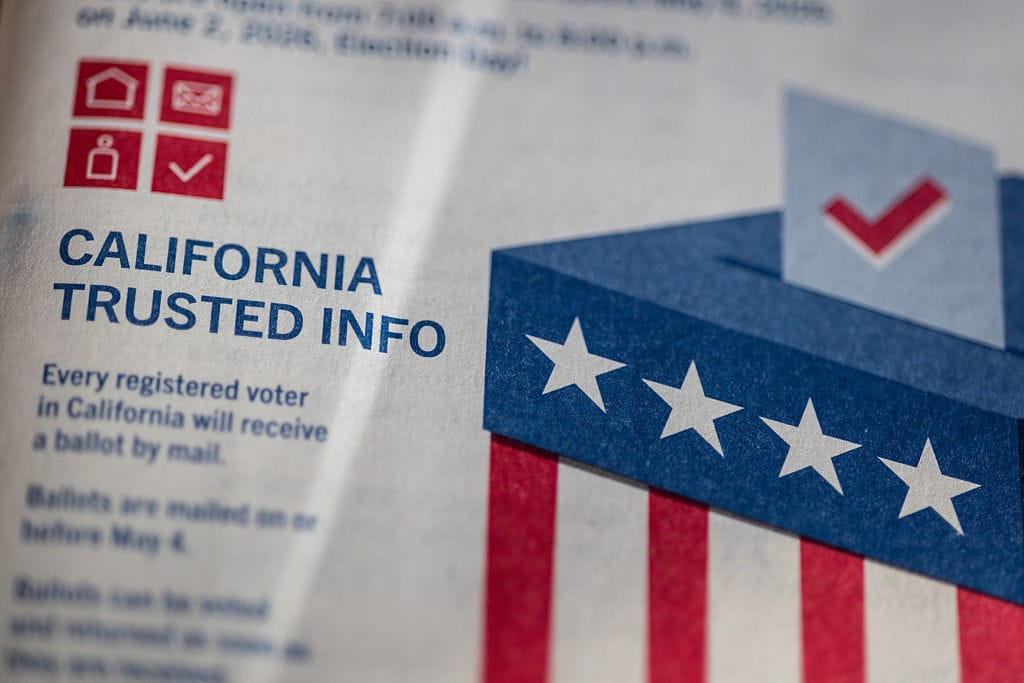
An official voter information guide mailed to a Southern California resident, ahead of a state primary election in Los Angeles, California. (Photo Illustration by Jay L Clendenin/Getty Images)
ZEV HURWITZ WOULD BE THE FIRST to tell you that he’s a political nobody.
He doesn’t hold elected office, possesses only 353 Instagram followers and has zero interest in building a following around partisan opinions. But he also has a master’s degree in public policy, spent his 18th birthday registering to vote and plows hours into ballot research.
“This is my Super Bowl,” the 33-year-old Pico-Robertson resident said of election season.
He first put his voting plans into a Google Doc a couple of election cycles ago, after friends kept asking him to walk them through ballot measures or explain who the judges were.
It’s since become a thing.
Earlier this month, Hurwitz’s phone pinged with a new message in the WhatsApp chain for young adults at his Modern Orthodox shul. The roughly 150-member group is typically dominated by arguments over the best kosher pizza or requests for plumber recommendations. But this time, an acquaintance had a different ask: Everyone, she said, was waiting for Hurwitz’s proposition explanations.
“I finished it this morning,” Hurwitz replied. “All 66 ballot items and how I’m planning to vote.” Then he added a few caveats: The list wasn’t for public distribution, nor was he looking to engage in debate. And these weren’t endorsements, he said of his “voter suggestions doc thing,” just a reflection of how he planned to fill out the ballot.
Hurwitz is one of a growing cohort of people sharing their personal ballot recommendations via Google Docs, PDFs and Notes app screenshots. The rise of these citizen-generated guides has been supercharged by a technological environment that makes it easier than ever to instantly share information on social media and in WhatsApp groups, family text chains and much-forwarded mass emails.
Some voting-guide makers see it as their civic duty to influence their friends and networks. Others, like Hurwitz, are more interested in sharing their research than political proselytizing.
The political microinfluencers cross demographic and party lines. There are retirees in wealthy suburbs, students, Eastside comedy writers, Hollywood machers, Valley moms and Venice surfers.
The common thread is that as Californians, they face an unusually — some would say absurdly — demanding ballot.
Take the official state voter guide mailed to voting households across California: It runs to 176 pages this year — and that doesn’t even include city or county races. Our state’s wonky ballot measure process essentially requires voters here to act as legislators, which leaves us trying to decipher what the heck any of these propositions would actually do. And that’s to say nothing of the three different types of judges we’re supposed to weigh in on.
Plus, the state has nonpartisan local elections, so party-minded voters can’t simply rely on the “D” or “R” next to a candidate’s name as a decision-making shortcut in city, county and judicial races. And even in Congressional and state Legislature races, California’s jungle-primary system dictates that the top two vote-getters advance, regardless of party, meaning voters are often tasked with choosing between Democrats.
How can a regular person with work and family obligations possibly be expected to figure all of this out? There are, of course, a glut of professional breakdowns and endorsements from various interest groups and outlets, but even navigating that can feel complicated, especially as fewer and fewer local newspapers offer nonpartisan takes on the election.
Into the void, a growing number of non-professionals have stepped up to act as Virgil-like guides to accompany their friends and family through California’s particular brand of voting hell.
“It's overwhelming and it's really confusing, and the vast majority of people don't have time,” said Susan Collins (unrelated to the Maine senator), a 63-year-old frequent political commentator who’s built a following on Instagram with colorful attacks on the DSA and a host of local politicians.
Collins curates a 33-page digital flipbook voting guide that she shares on her Instagram and also emailed to almost a hundred people. Though Collins, who lives in Calabasas, said she is a registered Democrat, she endorsed Republicans for the top-two state races.
Nickan Fayyazi, a former co-chair of the California Democratic Socialists of America, wouldn’t agree with most of Collins’ electoral choices. But she definitely relates to the feeling of ballot overwhelm. She has spent the last few cycles creating a bespoke progressive voting guide for a very niche audience: her Iranian extended family in the San Fernando Valley.
Her Google Doc, which she disseminates in the Mirzadeh family group chat, goes to her parents and a select group of aunts, uncles and cousins. All live in the West Valley except for an aunt in Thousand Oaks, who gets her own Ventura County-specific guide from her niece.
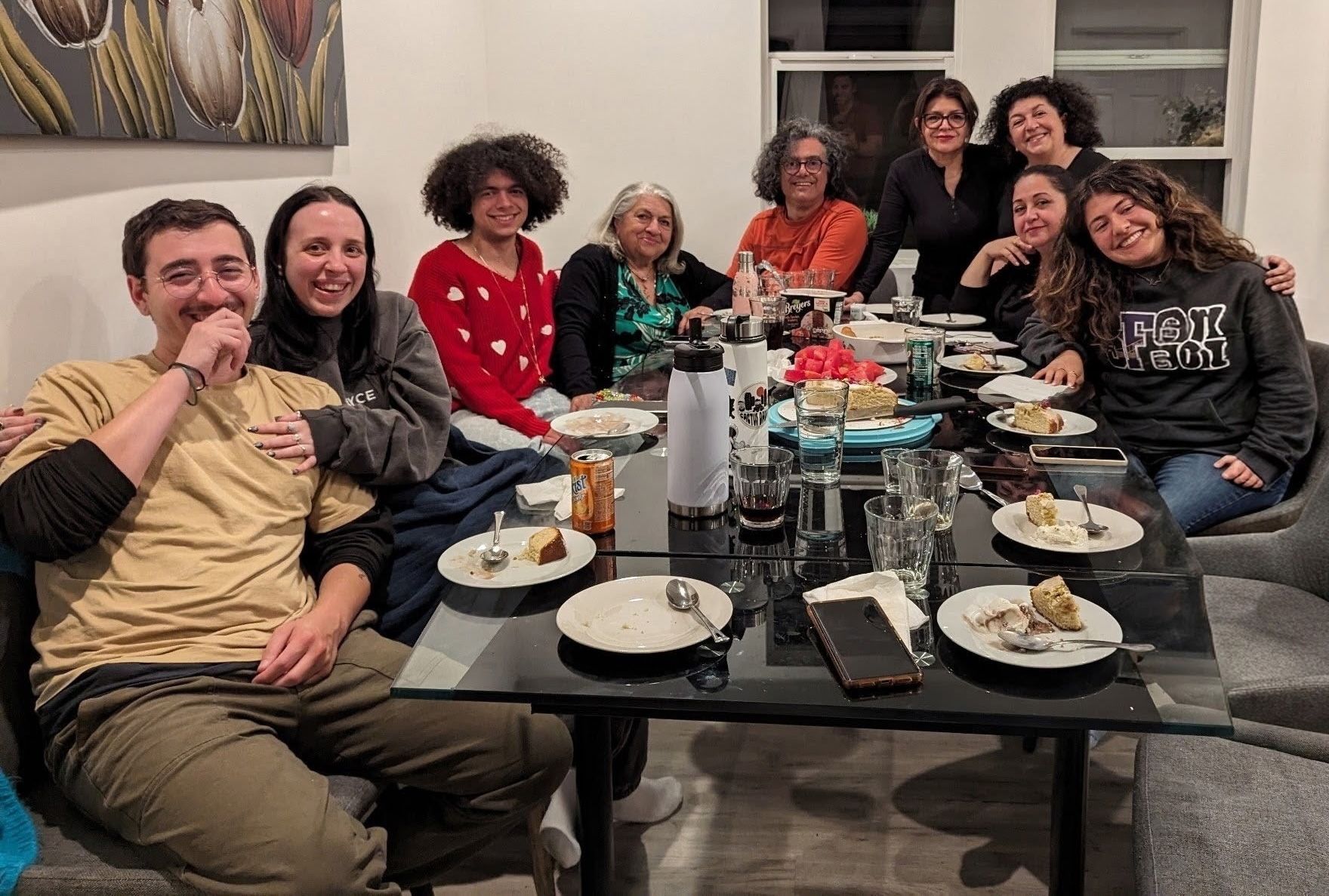
Members of the Mirzadeh family in 2024. (Photo courtesy of Nickan Fayyazi)
Fayyazi, who moved across the country this year to attend law school in New York and no longer votes in California herself, was relatively prompt with her research this year. But she has received haranguing texts and calls from relatives in the past when her guide didn’t arrive quickly enough.
Kristine Engemann, a 38-year-old Glendale resident who works in medical education, said she can “get pretty aggressive about trying to push people progressive” with her voting guide. But her efforts have been warmly received by her social network. One person even offered to Venmo her some appreciation cash. (She declined.)
Along with her own research, Engemann leans on guides and endorsements from several leftist groups, including DSA-LA, Knock LA and LA Forward. She also peruses several other citizen-generated write-ups, such as one put together by Eagle Rock architect Michael MacDonald.
Hurwitz, the Pico-Robertson denizen of the synagogue group chat, self-identifies as liberal but sees support for Israel’s right to exist as non-negotiable. In races where he is unfamiliar with both candidates, or sees them as otherwise tied, he will sometimes google their names alongside terms like “Israel,” “Palestine” and “antisemitism.”
“Like, at what point did this person post something on Instagram that is antithetical to my values?” he wondered aloud.

Zev Hurwitz (right), pictured with former Second Gentleman Doug Emhoff at a conference. (Photo courtesy of Zev Hurwitz)
Travis Helwig, a politically-outspoken leftist writer who has tens of thousands of followers on social media, said some of the more difficult decisions on his ballot guide came when sources he trusted, like DSA-LA and advocacy organization La Defensa, disagreed on their own recommendations.
“I’m like, ‘I’m a comedy writer, why am I trying to solve complex political problems?’ But now people demand it,” he joked. Nearly 1,000 people have shared his guide on Instagram, and the post has been viewed by more than 130,000 users.
Research has shown that the way people think their friends and family will vote can predict how they themselves will vote.
“We tend to surround ourselves with people we like and trust. So if they have advice then we might be more interested in listening to it,” Wändi Bruine de Bruin, a professor of psychology, public policy and behavioral science at USC, said via email.
Social influence in elections is as old as the idea of voting itself, according to John Gastil, a professor of political communications at Penn State University.
The Google Docs in your group chats are a natural extension of the ballot parties of yore where people gathered to discuss how to vote, he said.
“The only difference between that and today is now it's so much easier for me to come up with my voting guide [and] circulate it to my friends,” Gastil explained.

.jpg)